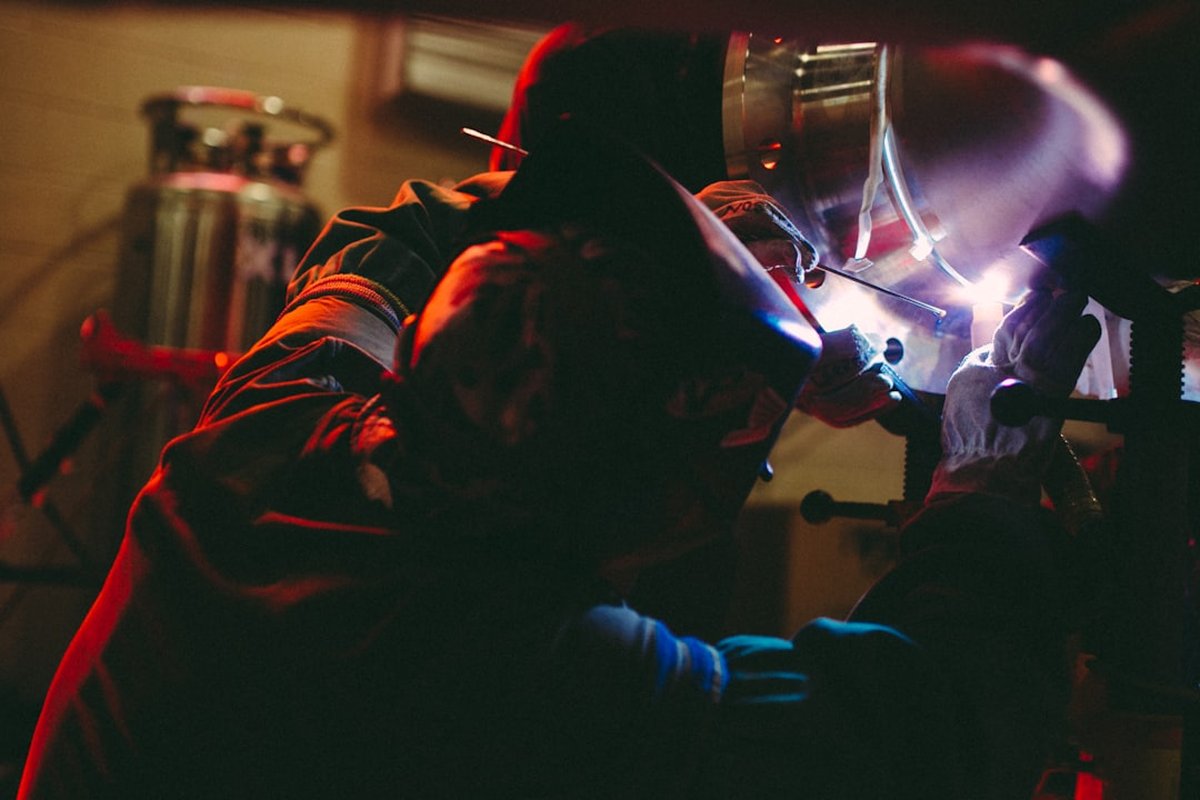
Introduction
When it comes to welding stainless steel, the TIG versus MIG debate has been running through fabrication shops for decades. Both processes can produce quality welds on stainless, but they excel in very different scenarios.
GTAW (Gas Tungsten Arc Welding, commonly called TIG) offers precision and superior aesthetics. GMAW (Gas Metal Arc Welding, or MIG) delivers speed and efficiency. The right choice depends on your specific application—material thickness, production volume, quality requirements, and your shop's economic realities.
This comparison breaks down both processes for stainless steel fabrication, helping you determine when each makes sense for job shop work versus high-volume production.

Quick Comparison Table
Before diving into the details, here's a high-level overview of how TIG and MIG stack up for stainless steel welding across the factors that matter most to fabricators.
| Factor | TIG (GTAW) | MIG (GMAW) |
|---|---|---|
| Weld Appearance | Excellent—stacked dimes aesthetic | Good—requires cleanup for cosmetic work |
| Heat Input | Low, precise control | Higher, faster heat buildup |
| Deposition Rate | 1–2 lbs/hour | 4–8 lbs/hour |
| Ideal Thickness | Thin gauge (24 ga–3/16") | Medium to thick (1/8" and up) |
| Skill Required | High—steep learning curve | Moderate—easier to train |
| Equipment Cost | Lower initial investment | Higher, especially for pulse |
| Consumable Cost | Tungsten + filler rod (lower) | Wire + gas (moderate) |
| Production Speed | Slow | Fast |
| Distortion Risk | Lower | Higher on thin material |
| Best For | Precision, thin gauge, visible welds | Production volume, thicker sections |
TIG Welding Stainless Steel: The Precision Choice
TIG welding remains the gold standard for stainless steel work where appearance and precision matter. The process uses a non-consumable tungsten electrode with separate filler rod addition, giving the welder complete control over heat input and filler deposition.
Why Fabricators Choose TIG for Stainless
The primary advantage of TIG on stainless steel is control. You're managing arc intensity with foot pedal or fingertip amperage control while independently adding filler metal. This separation allows you to weld thin-gauge stainless—down to 24 gauge or thinner—without burn-through.
TIG also produces the cleanest welds with minimal spatter and virtually no post-weld cleanup on properly executed joints. For food service equipment, pharmaceutical vessels, architectural metalwork, and any application where the weld will be visible, TIG delivers the aesthetics customers expect.
Heat Input Considerations
Stainless steel's low thermal conductivity and high coefficient of thermal expansion make it prone to distortion and sensitization (carbide precipitation in the heat-affected zone). TIG's precise heat control helps mitigate both issues.
Experienced TIG welders can maintain the interpass temperature below 350°F on 304/316 stainless, preserving corrosion resistance. The focused arc also minimizes the heat-affected zone width.
- Superior weld appearance with minimal cleanup
- Precise heat control prevents burn-through on thin material
- Lower heat input reduces distortion and sensitization
- Excellent for all positions including overhead
- Lower equipment and consumable costs
- Slow deposition rates hurt productivity
- Requires highly skilled welders
- Not practical for material over 1/4" without edge prep
- Fatigue factor on long production runs
- Sensitive to drafts and contamination
MIG Welding Stainless Steel: The Production Workhorse
MIG welding stainless steel has evolved significantly with modern power sources. Pulse MIG and advanced waveform control have addressed many traditional shortcomings, making GMAW increasingly competitive for quality-critical stainless applications.
Why Fabricators Choose MIG for Stainless
Speed is the obvious answer. MIG deposition rates of 4–8 pounds per hour dwarf TIG productivity. For shops running production quantities of stainless steel parts, this translates directly to profitability.
MIG also requires less operator skill to produce acceptable welds. Training a competent MIG welder takes weeks; developing a skilled TIG welder takes months or years. In today's labor market, that's a significant consideration.
Transfer Modes Matter
Short-circuit transfer works for thin stainless but produces more spatter and can cause cold lap defects. Spray transfer delivers better fusion and appearance but requires higher heat input—problematic on thin gauge material.
Pulse MIG threading the needle, offering spray-transfer quality at lower average heat input. Modern synergic pulse programs optimized for stainless steel (308L, 316L wire) have made MIG viable for applications previously reserved for TIG.
Shielding Gas Selection
Unlike carbon steel MIG where 75/25 (Ar/CO2) dominates, stainless MIG typically uses tri-mix gases: 90% He, 7.5% Ar, 2.5% CO2 or similar blends. Some shops run 98% Ar/2% O2 for better arc stability. The right gas selection affects bead profile, penetration, and oxidation levels.
- 3-4x faster than TIG on equivalent joints
- Lower operator skill requirements
- Excellent for thicker sections (1/8" and up)
- Consistent results with proper setup
- Easier to automate and mechanize
- Higher heat input risks distortion on thin material
- More spatter requires post-weld cleanup
- Equipment cost higher, especially pulse machines
- Shielding gas costs add up (tri-mix)
- Less aesthetic on visible welds
We switched our stainless handrail production from TIG to pulse MIG three years ago. Output tripled with comparable quality. But our food service work? That's still TIG only—customers expect those welds to look perfect.
Key Differences That Drive Your Decision
Beyond the spec-sheet comparisons, several practical factors should guide your process selection for stainless steel work.
Material Thickness
This is often the deciding factor. Below 1/8" thickness, TIG generally wins. The heat control prevents burn-through and distortion that plague MIG on thin stainless. From 1/8" to 3/16", either process works depending on other requirements. Above 3/16", MIG's productivity advantage becomes compelling unless aesthetics demand TIG.
Production Volume
One-off custom work and small batches favor TIG—setup time is minimal and the slower pace doesn't hurt overall job profitability. High-volume production swings heavily toward MIG. When you're welding hundreds of identical assemblies, MIG's speed advantage multiplies across every unit.
Weld Visibility
Will the weld be seen in the finished product? Architectural metalwork, food service equipment, and decorative stainless demand TIG's superior aesthetics. Structural welds hidden inside enclosures or covered by other components? MIG's good-enough appearance makes economic sense.
Welder Availability
Shops in regions with skilled TIG welder shortages may find MIG more practical simply due to staffing realities. A productive MIG welder you can hire beats an ideal TIG welder you can't find.
-
Under 1/8" typically favors TIG; over 3/16" favors MIG
-
Higher volumes amplify MIG's productivity advantage
-
Visible welds often demand TIG quality
-
TIG requires significantly more training investment
-
Leverage existing capabilities when possible
-
MIG may require grinding; TIG typically doesn't
The Economics: Job Shop vs. Production
The financial case for TIG versus MIG depends heavily on your shop's business model.
Job Shop Economics
Custom fabrication shops handling diverse stainless work often find TIG more economical despite slower welding speeds. Setup flexibility, lower equipment costs, and the ability to handle any thickness with one process offset productivity concerns. When you're quoting 5 different jobs per week across varying applications, TIG's versatility has real value.
Labor cost per weld inch runs higher with TIG, but job shops typically price accordingly. Customers paying for custom stainless work expect—and will pay for—TIG quality.
Production Economics
Repetitive manufacturing changes the calculus entirely. Consider a shop welding 200 identical stainless assemblies monthly. If MIG cuts weld time from 30 minutes to 10 minutes per unit, that's 67 hours saved monthly. At loaded labor rates of $75/hour, you're looking at $5,000+ monthly savings—easily justifying pulse MIG equipment investment.
The break-even point varies by application, but shops running consistent stainless production volumes typically recover pulse MIG system costs within 12–18 months through labor savings alone.
| Cost Factor | TIG Advantage | MIG Advantage |
|---|---|---|
| Equipment Investment | ✓ Lower initial cost | — |
| Consumables | ✓ Tungsten lasts; filler costs less | — |
| Shielding Gas | ✓ Straight argon is cheaper | — |
| Labor per Weld Inch | — | ✓ 3-4x faster |
| Training Investment | — | ✓ Faster to competency |
| Post-Weld Cleanup | ✓ Minimal required | — |
| High-Volume Production | — | ✓ Significantly lower cost/part |
Verdict: Choosing the Right Process
There's no universal winner in the TIG versus MIG stainless steel debate—but there are clear winners for specific applications.
Choose TIG When:
- Welding thin-gauge stainless (under 1/8")
- Aesthetics matter and welds will be visible
- Working on food service, pharmaceutical, or sanitary applications
- Handling custom, low-volume fabrication
- Maximum corrosion resistance is critical
- Your shop already has skilled TIG welders
Choose MIG When:
- Running production quantities of similar parts
- Material thickness exceeds 3/16"
- Welds will be hidden or ground flush anyway
- Training new welders quickly is necessary
- Automation or mechanization is planned
- Cost-per-part drives profitability
The Hybrid Approach
Many successful stainless steel fabricators maintain both capabilities. TIG handles precision work, root passes on critical joints, and customer-facing welds. MIG fills and caps thicker sections and runs production work. This flexibility lets shops bid on diverse work while optimizing each application.
The best process is the one that meets your quality requirements at the lowest total cost. For some shops, that's TIG. For others, MIG. For many, it's strategically deploying both.
Evaluate your typical stainless work against the factors above, run the numbers on your specific applications, and let the economics guide your decision. The welding process is a tool—choose the right one for each job.
Comments
No comments yet. Be the first to comment!
Leave a Comment